









Workers
What happens once a single spoon stops being enough? That is the moment Dirt Clicker quietly hands you its real system — a crew of hireable workers who take over the digging so you can stop clicking and start managing. Understanding what each worker actually does, and when to hire one type over another, matters more than almost any other decision in the early game.
| Worker | Role |
|---|---|
| Mushroom Buddies | Early automated diggers, cheap to hire in numbers |
| Dirt Golems | Sturdier automated diggers built for deeper layers |
| Druids | Support-oriented hires tied into the wider skill tree |
| Frog Pal | Applies a dirt multiplier rather than digging directly |
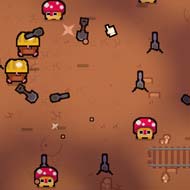
Mushroom Buddies: Dirt Clicker’s First Real Crew
Mushroom Buddies are typically the first workers players hire once the initial manual-digging stretch with just a spoon starts to feel slow. They are inexpensive relative to later hires, which makes them the obvious first investment — a handful of Mushroom Buddies working at once already outproduces solo clicking by a wide margin.
Where new players tend to go wrong is stopping at a small number of Mushroom Buddies because the early payoff feels satisfying enough. Their output per hire is modest by design, meant to be a stepping stone rather than a long-term core strategy — leaning on them too long past the point other workers become available slows overall progress more than it should.
Mushroom Buddies also tend to be the worker type players reference when comparing Dirt Clicker’s pacing to other digging incrementals, since how quickly a run gets past its Mushroom Buddy phase says a lot about how efficiently the rest of a build is put together.
Dirt Golems and the Push Into Deeper Layers
Dirt Golems read as a sturdier, more deliberate hire than Mushroom Buddies — built less for cheap early throughput and more for sustaining digging output once layers start demanding more from your workforce. Players pushing toward the purple-tinted depths and the lava-lit layer further down tend to lean on Dirt Golems specifically to keep pace with terrain that punishes a thin, all-Mushroom-Buddy crew.
The trade-off is cost. Dirt Golems ask for more investment than Mushroom Buddies do, and hiring them too early — before the gold income to support them is really there — can stall a run rather than accelerate it. Reading your own income before committing to a Dirt Golem-heavy crew matters more here than with cheaper hires.
Druids and the Skill Tree Connection
Druids stand apart from the more straightforwardly extractive Mushroom Buddies and Dirt Golems by leaning into Dirt Clicker’s skill tree rather than working independently of it. Players building around skill tree investment tend to find Druids pull more weight than their raw digging numbers alone would suggest, since their value compounds with nodes that would otherwise sit unused.
This makes Druids a harder worker to evaluate at a glance. A player judging every hire purely on digging output per gold spent will likely undervalue Druids compared to someone who has already sunk points into the parts of the skill tree that make them worthwhile.
Frog Pal and the Dirt Multiplier
Frog Pal breaks from the digging-worker pattern entirely — rather than clearing dirt directly, Frog Pal applies a multiplier to dirt gathered by the rest of your crew. That distinction matters for sequencing: hiring Frog Pal before you have much of a crew to multiply wastes most of its value, while hiring it once Mushroom Buddies, Dirt Golems, or Druids are already established turns it into one of the stronger single hires available.
Players who hire Frog Pal too early sometimes conclude it is a weak worker, when the actual issue is sequencing rather than the worker itself. Multiplier-based hires in general reward patience more than immediate hires do.
Naming and Managing a Growing Crew
As the crew grows past a handful of workers, Dirt Clicker gives players the ability to name individual hires and track stats on how each one is performing. This is a small touch, but it matters once you are running enough workers that treating them as an undifferentiated mass stops making sense — knowing which specific Dirt Golem is underperforming is more useful than just watching an aggregate output number climb.
Stat tracking at the individual worker level also helps with a mistake newer players commonly make: continuing to hire more of a worker type that is already underperforming for their current layer, instead of noticing the trend and diversifying the crew instead.
Balancing Hires Against Dirt Clicker’s Skill Tree
Because the skill tree touches so much of Dirt Clicker’s progression, worker hiring decisions rarely happen in isolation from it. A crew leaning heavily on Druids wants a different allocation of skill points than a crew built around raw Mushroom Buddy and Dirt Golem numbers, and players who treat hiring and skill tree spending as two separate decisions tend to end up with a crew that fights its own build rather than reinforcing it.
The players who get the most out of their crew tend to revisit this balance regularly rather than setting it once early on — what worked at the surface layers rarely holds up unchanged once purple-tinted depths and the lava-lit layer are in view.
- Which worker should I hire first in Dirt Clicker? Mushroom Buddies are the standard first hire — cheap enough to buy in numbers early, and a clear upgrade over manual spoon-digging alone.
- Is it worth hiring Frog Pal early? Generally not before you already have other workers established, since Frog Pal multiplies existing dirt output rather than generating much on its own.
- Do Druids work well without skill tree investment? Not particularly — Druids are built to pair with the skill tree, and their value is easy to underrate if you are judging them purely on raw digging output.
- Should I keep hiring the same worker type as I progress? Usually not indefinitely — Mushroom Buddies that carried the early layers tend to need Dirt Golem or Druid support once deeper, harder terrain shows up.
Dirt Clicker’s crew system rewards the same thing good management always rewards — knowing which worker fits which job, rather than assuming more Mushroom Buddies is always the answer once Dirt Golems and Druids are sitting there, underused, in the hiring menu.