











Universe Sandbox 2



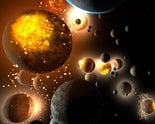
A single misplaced comet in Universe Sandbox 2 can end a planet’s atmosphere in seconds — not because the game scripts a dramatic collision sequence, but because the physics underneath is real enough that a bad trajectory genuinely does that on its own. Universe Sandbox 2 is less a game with levels and more a sandbox where the rules are the actual laws of gravity, collision, and material interaction.
Newtonian Gravity as the Core Mechanic
Every object in Universe Sandbox 2 — star, planet, moon, comet — pulls on every other object through genuine N-body gravitational simulation, run in real time at whatever speed you choose to watch it unfold. This is what separates it from a scripted space game: nothing here is animated to look right, it is calculated to behave correctly, which means the same setup can play out differently depending on tiny changes to starting conditions.
New users often start by dropping a star into empty space and building outward from there — adding planets, then moons, then rings or a comet on a collision course just to see what happens. That instinct to experiment is really the entire point of the sandbox; there is no wrong way to set up a system, only different outcomes to observe.
Building Planets From Real Materials
Rather than treating planets as fixed presets, Universe Sandbox 2 lets you construct them from a material system built around elements like hydrogen, iron, rock, and water. Changing a planet’s material composition changes how it behaves under gravity and heat, which means two planets that look similar on the surface can respond completely differently once a collision or a close stellar pass puts them under stress.
This is where players get the most out of the game once the initial novelty of watching planets orbit wears off — treating material composition as a variable to experiment with, rather than a fixed property, opens up a much deeper layer of the simulation.
Collisions, Atmospheres, and Stellar Evolution
Universe Sandbox 2’s collision system does not fake the aftermath of a planetary impact — atmospheres strip away, debris scatters, and the resulting body reflects the actual physics of what just happened rather than a pre-set animation. Stellar evolution runs on similar logic, letting stars age, expand, and collapse according to the same underlying rules that govern real astrophysics.
Watching a star’s evolution play out over a compressed timescale is one of the more genuinely striking things the simulation offers, precisely because nothing about it is staged for the moment — the star is simply following its own physical trajectory forward.
Black Holes, Nebulae, and Recent Additions
Beyond standard planetary and stellar bodies, Universe Sandbox 2 visualizes black holes and simulates fluid-like objects such as gas clouds, nebulae, and protoplanetary disks. More recent additions have expanded this further with Neutron Stars, Pulsars, and dark matter clouds, broadening what kind of exotic scenario a player can actually construct and watch unfold rather than just read about.
Multiplayer functionality has also been added, letting more than one person build and manipulate the same simulated system together — a meaningful shift for a game that started as a fundamentally solitary sandbox experience.
Do I need to understand real astrophysics to use Universe Sandbox 2?
No — the simulation handles the underlying physics for you, and a lot of the appeal comes from experimenting freely and observing outcomes rather than calculating them in advance.
Can I actually destroy a planet in Universe Sandbox 2?
Yes — collisions calculated through the game’s real physics can strip atmospheres, shatter bodies, or merge them entirely, depending on mass, speed, and material composition at the moment of impact.
What changed with the addition of Neutron Stars and Pulsars?
They expanded the range of exotic stellar objects available to simulate directly, alongside dark matter clouds, giving players more unusual scenarios to build beyond standard star-and-planet systems.
Universe Sandbox 2 keeps circling back to the same basic thrill — set something in motion, whether it is a comet aimed at a fragile atmosphere or a star pushed toward the end of its life, and watch real physics decide what happens next instead of a script.
Comments
There are no reviews yet. Be the first one to write one.