










Depths
You clear the surface layer without much trouble, drop into the next one, and the dirt underfoot is suddenly tinted purple instead of brown. Nothing announced that shift — Dirt Clicker just lets the terrain itself tell you that the rules for what you find, and how hard it is to find, have quietly changed.
| System | What It Governs |
|---|---|
| Layers | Depth progression, visual theme, difficulty of what you dig through |
| Chests | Guaranteed reward pulls, gated by keys including the Evil key |
| Relics | Passive stat bonuses tied to what you have uncovered |
| Spells | High-impact, potentially run-defining boosts |
What Actually Changes Between Layers in Dirt Clicker
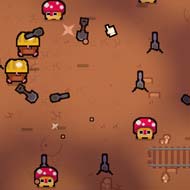
Each layer in Dirt Clicker carries its own visual identity — ordinary topsoil gives way to purple-tinted depths, and further down a lava-lit layer changes the tone of the dig entirely. These are not just cosmetic backdrops; the shift in appearance tends to track a real shift in what a layer demands from your crew and your tools, which is why a setup that cleared the surface with ease can suddenly feel underpowered a layer or two later.
Players consistently underestimate how much a new layer’s difficulty jump matters until they hit one unprepared. The purple-tinted depths in particular get mentioned often as the point where a casual, undirected approach to hiring and upgrades stops being good enough.
Deciding Whether to Fully Explore or Move On
Dirt Clicker deliberately puts a real choice in front of you at every layer: dig up everything a layer has to offer, including relics and puzzle pieces tucked into specific spots, or push on toward the next layer and whatever it holds instead. There is no universally correct answer — full exploration banks more of a layer’s rewards but costs time that could be spent progressing deeper, where later layers may offer better rewards per minute spent digging.
This tension is one of the more talked-about parts of the game among players who have spent real time with the demo. Some treat every layer as a checklist to clear completely before moving on; others treat early layers as a formality to rush through on the way to deeper, more rewarding terrain. Neither approach is wrong, but they lead to noticeably different runs.
Chests, Keys, and the Evil Chest
Chests scattered through the dig site offer a more guaranteed form of reward than digging blindly through dirt, but most require a key to open rather than being freely accessible. The Evil Chest specifically only appears after an Evil key has already spawned, which makes it a two-step reward rather than a simple find — first locating the key, then locating or reaching the chest itself.
New players sometimes dig past a chest assuming they can return to it later without the right key in hand, only to find retrieving that specific reward now requires backtracking through terrain they have already cleared. Recognizing chest locations and prioritizing the keys that unlock them is a small habit that pays off more than it seems like it should early on.
Relics and What Passive Stats Actually Mean
Relics function differently from ordinary dug-up items — rather than being sold or displayed, they contribute passive stat bonuses that persist as part of your ongoing progress. This makes relic-hunting a longer-term investment than most other digging activity in Dirt Clicker, since the payoff is not an immediate resource boost but a permanent, if usually modest, improvement to how your whole operation performs.
Because relics reward passive stats rather than instant gratification, they are easy to deprioritize in the moment, especially on a layer where a player is racing to reach the next one. Players who consistently detour for relics tend to report a smoother time in deeper layers specifically because those passive bonuses have had time to stack up.
Spells: Dirt Clicker’s Riskier Skill Tree Payoff
Where the skill tree’s more conventional nodes offer steady, predictable improvements to digging power and loot odds, spells sit apart as a higher-variance, higher-impact option — the game itself frames some spells as strong enough to break its own intended pacing. That framing shows up in how players actually talk about them: spells are treated less as a default part of every build and more as a deliberate choice to lean into for players chasing faster, more aggressive progress.
Timing matters more with spells than with most other systems in Dirt Clicker. Investing in them too early, before there is much of a digging and worker foundation to amplify, tends to underwhelm compared to holding off until spells have a stronger base to multiply.
Items and Puzzle Pieces Worth Digging For
Beyond chests and relics, Dirt Clicker scatters more than 40 distinct valuable items and rare puzzle pieces across its layers, giving digging itself a reason to feel worthwhile even outside of guaranteed chest pulls. Puzzle pieces in particular reward players willing to dig thoroughly rather than efficiently, since they tend to sit in spots a rushed pass through a layer would simply miss.
Balancing thorough digging against the pull to progress deeper is really the same tension the layer-exploration decision comes down to, just expressed at a smaller scale — every dig is a tiny version of the same choice between what is here now and what might be one layer further down.
Do I need a specific key for every chest, or just the Evil Chest?
Keys are specifically tied to certain chest types, with the Evil key and Evil Chest being the clearest example — always check whether a chest you find is one that requires a key before assuming it can simply be opened on sight.
Are relics worth detouring for if I am trying to progress quickly?
Usually yes over a longer run, since their passive stat bonuses compound across every layer that follows — the cost is mostly time spent now for a smoother experience in layers you have not reached yet.
When is the right time to start using spells?
Once a real digging and worker foundation is established rather than at the very start — spells amplify what you already have going, so using them too early tends to underdeliver compared to a build that has something worth amplifying first.
Dirt Clicker keeps handing you the same basic decision in slightly different clothes at every layer — dig deeper now, or dig thoroughly here first — and whether you are chasing a relic’s passive bonus or finally cashing in a spell strong enough to break the game’s own pacing, that same choice is what actually shapes how each run through Dirt Clicker plays out.